Natural Smile Makeovers: Cosmetic Dentistry Guide
Natural Smile Makeovers: Cosmetic Dentistry Guide
Table of Contents
- What Makes a Cosmetic Dentistry Result Look Natural
- Composite Bonding for Natural Teeth
- Natural-Looking Veneers: Materials and Design
- Adult Teeth Straightening Without Extraction
- Teeth Whitening and Its Role in Smile Design
- Costs, Longevity, and Maintenance Across Treatments
- Choosing a Cosmetic Dentist for Results You’ll Love
- Frequently Asked Questions
Last Updated: October 10, 2026
What Makes a Cosmetic Dentistry Result Look Natural
A natural-looking smile comes down to proportion, colour, and alignment working together seamlessly. The best cosmetic dentistry for natural smile outcomes respects your facial structure rather than imposing a generic template. (Source: guidance from the General Dental Council (GDC))
Natural teeth vary in tone, have texture, and sit at subtly different angles. A dentist who understands this creates results that blend with your face. The key is matching tooth shade to your skin tone, sizing teeth proportionally to your lips and face width, and positioning them to follow your natural bite line.
Choosing a dentist based on price alone is a common mistake. Cosmetic dentistry natural smile work requires both technical skill and aesthetic judgment; cheaper options often result in overdone, too-white, or mismatched outcomes.
Composite Bonding for Natural Teeth
Composite bonding applies tooth-coloured resin directly to your teeth to improve shape, close gaps, or repair chips. It’s minimally invasive and reversible, requiring minimal tooth preparation and making it the fastest, most conservative option for small cosmetic changes.
Results look natural because the resin matches your existing shade and mimics enamel translucency. The process works well for closing gaps, repairing worn edges, or adjusting tooth shape.
The main limitation is durability: composite bonds are prone to staining. They’re better suited as a temporary fix or minor adjustment than a complete smile transformation.
Composite bonding is ideal if you want reversibility and minimal tooth preparation. It’s a good way to test cosmetic changes before committing to veneers or other permanent treatments.
Natural-Looking Veneers: Materials and Design
Porcelain veneers are thin shells that transform shape, size, and colour. They’re the gold standard for comprehensive smile makeovers because they deliver long-lasting, natural-looking results. Porcelain is stronger, more stain-resistant, and more lifelike than composite veneers.
The design phase determines whether results look natural or fake. Your dentist should photograph your smile from multiple angles, measure proportions relative to your lips and face, and propose a shade and shape suited to your facial features.
Preparation involves removing a thin layer of enamel (roughly 0.5 mm), a permanent change. The veneers are then bonded in place with dental cement, creating a transformed smile that functions like natural teeth.
How Long Do Veneers Last and What Affects Durability
Grinding your teeth, chewing ice, or using teeth as tools accelerates wear. Discuss these habits with your dentist before committing to veneers.
Brush gently with a soft toothbrush, avoid abrasive whitening products, and see your dentist every six months. A night guard is recommended if you grind your teeth. If a veneer chips, it can usually be repaired or replaced individually without replacing all of them.
Adult Teeth Straightening Without Extraction
Straight teeth are central to a natural-looking smile. Clear aligners (custom-made plastic trays) are the most popular choice for adults, nearly invisible, removable, and unrestricting.
Both approaches achieve excellent results without extracting healthy teeth and can be combined with veneers or whitening for a complete transformation.
Adult teeth straightening is now subtle enough that most people won’t notice you’re undergoing treatment. Combined with other cosmetic treatments, it creates a foundation for a truly natural-looking smile.
Teeth Whitening and Its Role in Smile Design
Professional whitening brightens teeth several shades but should aim for a natural shade that suits your skin tone, not the brightest possible white. In-surgery whitening takes about an hour; take-home trays work over 1-2 weeks. Both are significantly more effective than shop-bought products.
Whitening works only on natural enamel, not veneers or crowns. If planning cosmetic work, whiten first, then design veneers to match.
Costs, Longevity, and Maintenance Across Treatments
Choosing a cosmetic dentistry natural smile treatment means weighing upfront cost against longevity and maintenance. Understanding what affects price helps you make an informed decision.
Treatment Comparison: Cost, Lifespan, and Maintenance
| Treatment | Typical Cost Range | Longevity | Maintenance Needs | Reversibility |
|---|---|---|---|---|
| Composite Bonding | £150-£400 per tooth | 5-7 years | Regular polishing, stain avoidance | Fully reversible |
| Porcelain Veneers | £800-£2,000 per tooth | 10-15 years | Gentle brushing, night guard if grinding | Permanent enamel removal |
| Clear Aligners | £1,500-£5,000 (full course) | Permanent (retention needed) | Wear retainer nightly | Fully reversible |
| Professional Whitening | £300-£800 (in-surgery) | 6-24 months | Avoid staining foods, periodic touch-ups | Fully reversible |
| Dental Implants | £1,500-£3,500 per tooth | 15-25+ years | Normal brushing and flossing | Permanent |
Note: Costs vary by region, practice, and complexity. For current pricing, please contact Smile Design Studio directly.
What Drives Cosmetic Dentistry Costs
Several factors influence the final price you’ll pay, beyond the treatment type itself:
Material quality. Premium laboratory ceramics and high-grade resins cost more upfront but last longer and require fewer touch-ups.
Dentist experience. A cosmetic dentist with advanced training and a reputation for natural-looking work typically charges more than a general dentist offering cosmetic services as an add-on.
Complexity and time. A single composite bond costs less than a full-mouth veneer case requiring 8-10 teeth and precise shade matching.
Laboratory fees. Premium laboratories charge more for custom work.
Value Over Time: The Cost-Per-Year Calculation
Cost per year of wear is more useful than upfront cost alone.
If you plan to keep your cosmetic work for a decade or more, some treatments may deliver better value than repeatedly replacing others, even though the initial outlay is higher.
Maintenance Costs and Hidden Expenses
Beyond the treatment itself, factor in ongoing care:
Composite bonding requires professional polishing every 6-12 months (£50-£100) and a night guard if you grind (£200-£400).
Porcelain veneers need only gentle brushing and flossing, but a night guard is essential if you grind.
Clear aligners require a nightly retainer (£300-£600) after treatment.
Professional whitening touch-ups cost £150-£300 every 6-12 months.
Dental implants require excellent oral hygiene; repairs cost £500-£2,000 if complications arise.
Staged Treatment: Spreading Cost Over Time
A staged approach spreads cost over 2-3 years: start with orthodontics (12-18 months), add veneers or bonding once teeth are straight, then finish with professional whitening. This allows you to assess results at each stage. If budget is tight, composite bonding on your most visible teeth is an affordable way to test changes before investing in veneers.
Ask your dentist for a written treatment plan that breaks down cost by phase, expected longevity for each treatment, and maintenance requirements. This helps you budget realistically and understand the true cost of ownership over time.
Choosing a Cosmetic Dentist for Results You’ll Love
The difference between a natural-looking smile and an overdone one comes down to your dentist’s experience and aesthetic judgment. You need someone who understands facial proportions, listens to your vision, and can articulate why a design suits you.
Credentials and Specialist Training
Check their qualifications. Verify registration with the General Dental Council (Registration). Look for postgraduate training in cosmetic or restorative dentistry, such as membership in the British Academy of Cosmetic Dentistry (BACD) or postgraduate diplomas in aesthetic dentistry (Accreditation). Advanced training indicates understanding of modern techniques and aesthetic principles.
Ask about their experience. How many cosmetic cases have they completed? How long have they been focusing on cosmetic work? A dentist with extensive cosmetic-focused practice will have refined their eye for natural aesthetics.
Before-and-After Portfolio and Case Selection
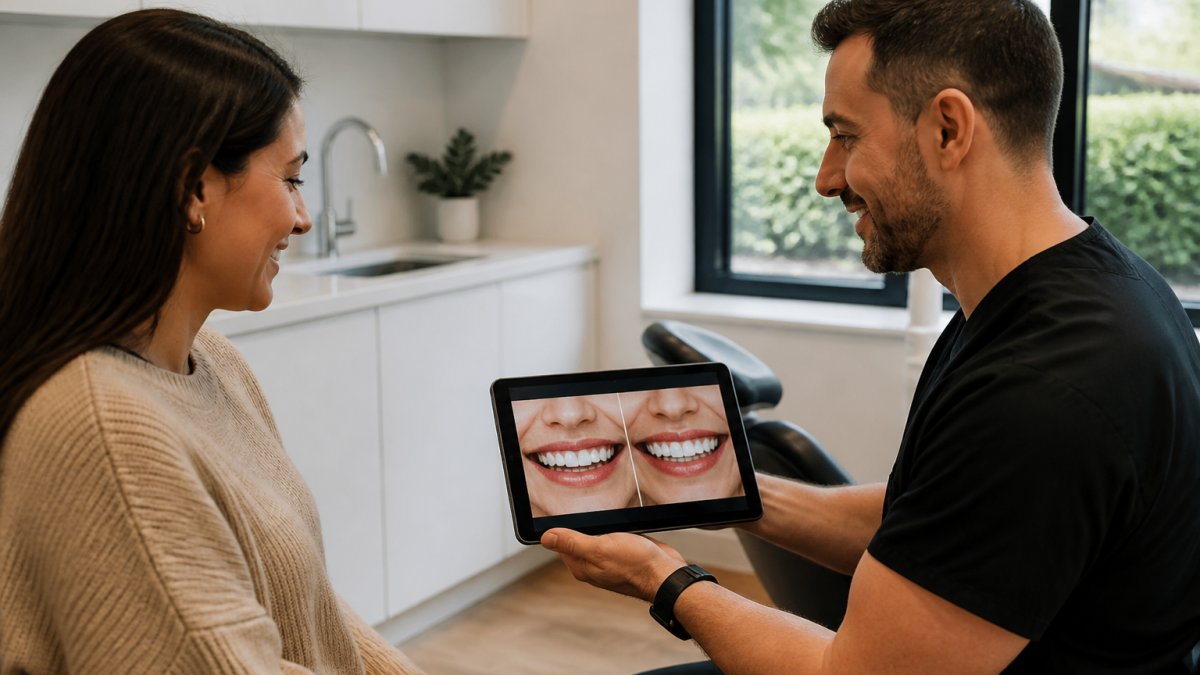
Request to see their actual patient work. Any dentist worth seeing will have a before-and-after portfolio. Look for consistency and subtle results, not just dramatic transformations. Ask specifically to see cases similar to yours.
Assess the aesthetic quality. Natural-looking veneers should match skin tone, vary slightly in shade, show subtle texture and translucency, sit at natural angles, and appear proportional to lips and face width. If all after photos show very white, very large, uniform teeth, that’s a red flag suggesting a template approach rather than customisation.
Design Process and Communication
Spend time on consultation before committing. A good cosmetic dentist will photograph your smile from multiple angles, measure proportions, discuss your wants in detail, show shade options, and use mock-ups or digital previews before permanent treatment. If a dentist rushes or pressures you to decide on the day, that’s a red flag.
Ask about their design philosophy. How do they decide on tooth size, shape, and shade? Do they use facial analysis tools or digital smile design software? A dentist who can articulate their reasoning is more likely to deliver results you’ll love.
Request a written treatment plan. Before any treatment begins, you should have a document that outlines:
- The specific treatments recommended and why
- Expected outcomes and limitations
- Cost breakdown by phase
- Timeline for each stage
- Aftercare and maintenance requirements
- What happens if you’re unhappy with results
A written plan protects both you and the dentist and ensures you’re on the same page.
Red Flags to Avoid
Pressure to choose the most expensive option without discussion. A good dentist recommends treatments based on your needs and budget, not profit margin.
Reluctance to discuss risks or limitations. Every treatment has trade-offs; a dentist who glosses over these is not being honest.
No discussion of your concerns. A good dentist listens and explains how they’d approach your concerns differently.
Unwillingness to show natural-looking examples. If a dentist can only show dramatic transformations, they may lack experience with subtle results.
No aftercare policy. Ask what happens if something goes wrong. A confident dentist will offer touch-ups, adjustments, or a clear repair policy.
Questions to Ask at Your Consultation
Bring a list of specific questions:
- How long have you been focusing on cosmetic dentistry, and what training have you completed?
- Can I see before-and-after photos of cases similar to mine?
- What design process will you use to ensure my results look natural?
- Will I see a mock-up or digital preview before treatment begins?
- What are the risks and limitations of the treatment you’re recommending?
- How long will the results last, and what maintenance is needed?
- What is your policy if I’m unhappy with the results or if something goes wrong?
- Do you offer a night guard if I grind my teeth, and is it included in the cost?
- How will you ensure my smile looks natural and suits my face, not just follow a template?
- Can you provide references or testimonials from patients who had similar work?
A dentist who answers these clearly and patiently is more likely to deliver results you’ll trust.
Don’t choose a dentist based on price alone or because they’re convenient. Cosmetic dentistry is visible every day; investing time to find a dentist with genuine aesthetic skill and a collaborative approach is worth the effort. A second opinion costs little and can save you from an expensive mistake.
Frequently Asked Questions
What cosmetic dentistry treatments look the most natural?
Composite bonding and porcelain veneers rank highest for natural appearance when designed by an experienced cosmetic dentist. Bonding works best for minor gaps and chips, while veneers suit broader smile transformations. The key is matching tooth shade to your natural teeth, respecting your face shape, and maintaining proper bite alignment. Clear aligners for adult teeth straightening also deliver natural results without altering tooth structure. Your dentist should show you before-and-after examples and discuss shade, shape, and proportion during your consultation.
How long do veneers last and what maintenance do they need?
Longevity depends on bite force, grinding habits, and daily care. Avoid chewing hard objects, wear a night guard if you grind your teeth, and maintain regular brushing and flossing. Veneers cannot be whitened, so tooth whitening should happen before veneer placement. Your dentist will discuss aftercare during your treatment plan consultation.
Is composite bonding or veneers better for a natural-looking smile?
Both can look natural, but they suit different situations. Composite bonding for natural teeth is less invasive, reversible, and ideal for small imperfections like chips or gaps. Veneers offer superior stain resistance and durability for more extensive smile makeovers. Your cosmetic dentist will recommend the best option based on your tooth structure, desired outcome, and budget during your consultation.
How do I know if a cosmetic dentist will deliver natural results?
Ask to see before-and-after photos of similar cases, check patient reviews and testimonials, and discuss your specific concerns during the consultation. A good cosmetic dentist will explain their smile design process, show you mockups or digital previews before treatment, and prioritise matching your natural tooth shade and facial proportions. Avoid dentists who promise painless or risk-free treatments, or who rush through the consultation. Request a detailed treatment plan in writing, and don’t hesitate to seek a second opinion if you feel uncertain.
Related posts