Tooth Decay Treatment Options Explained

Tooth Decay Treatment Options Explained
Quick Summary
Tooth decay treatment depends on how far the damage has progressed. Early decay in the enamel can often be managed with fluoride and monitoring, while a formed cavity usually needs a filling, and deeper decay may require a crown or root canal treatment. A dental examination and X-rays are needed to decide which option fits.
- Decay is easiest to treat when it is caught early, before it pierces the enamel.
- Professionally applied fluoride varnish can help early white spots remineralise over time.
- Fissure sealants protect deep grooves in back teeth where plaque collects easily.
- Pain is not a reliable guide, so an assessment with X-rays is recommended.
- Root canal treatment can preserve a tooth whose decay has reached the pulp.
Table of Contents
- What Tooth Decay Is and Why Early Treatment Matters
- Tooth Decay Stages and How Severity Changes Your Options
- Early Tooth Decay Treatment: Fluoride, Sealants and Monitoring
- Fillings, Crowns and Root Canal Treatment for Tooth Decay
- How Long Does Tooth Decay Treatment Take?
- Costs, Recovery and Aftercare for Each Treatment Option
- Booking Your Assessment at Smile Design Studio
- Frequently Asked Questions
Tooth decay treatment options explained: the honest starting point is that decay is easiest to deal with when it is caught early. Decay can be found at every stage, from a small spot that has only started to soften the enamel to a tooth where the decay has reached the nerve. The treatment you need depends almost entirely on how far the decay has progressed, which is why an assessment matters before anything else.
NHS guidance on tooth decay and cavities describes decay as damage to the hard surface of the tooth caused by acids produced when bacteria in plaque break down sugars. Once that damage is established, the enamel cannot rebuild itself, so the goal shifts from reversing the problem to stopping it from getting worse.
What Tooth Decay Is and Why Early Treatment Matters
Tooth decay is the progressive breakdown of enamel, and then dentine, by acid. Plaque bacteria feed on sugars and release acid that dissolves minerals from the tooth surface. Saliva works against this by returning minerals, a process called remineralisation, but only while the damage is still shallow.
Early treatment matters because the cost of waiting rises quickly. A small area of demineralisation can often be managed with fluoride and changes to diet and brushing. A cavity that has pierced the enamel usually needs a filling, and decay that has reached the pulp may need root canal treatment or extraction. Each stage removes options that were available earlier.
Tooth Decay Stages and How Severity Changes Your Options
Decay usually moves through recognisable stages. In the first, the enamel loses minerals and may look chalky or show white spots. In the second, a cavity forms in the enamel. Later stages involve the dentine beneath, and finally the pulp, where the nerve and blood supply sit.
Pain is not a reliable guide to severity. Many people with significant decay feel nothing until the nerve is involved, while sharp sensitivity to cold can signal decay that is still relatively superficial. This is why a clinical examination and X-rays are important, and why we recommend booking an assessment rather than waiting for symptoms.
Early Tooth Decay Treatment: Fluoride, Sealants and Monitoring
The conservative approach works best when decay is still confined to the enamel, the outer mineral layer of the tooth. At this stage the surface may look chalky, slightly rough, or show a white or brownish spot, but the tooth has not yet been cavitated. Because enamel can remineralise when minerals and fluoride are available, the aim is to create conditions in which the spot can stabilise rather than to remove anything.
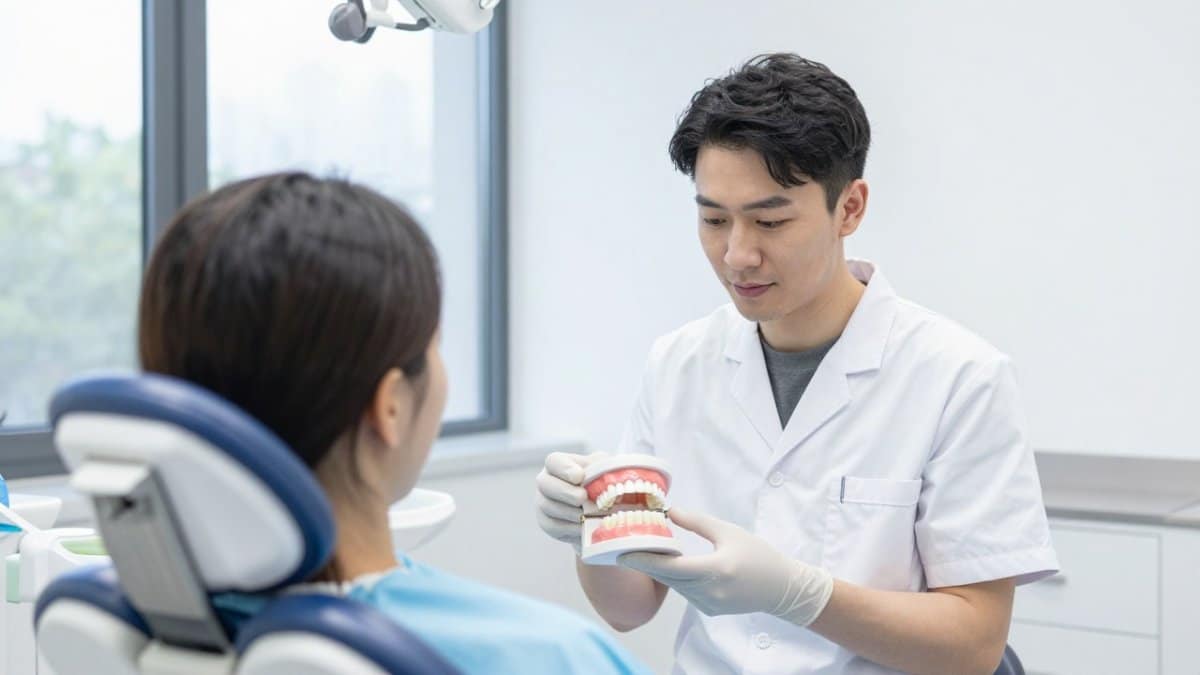
Fluoride is the main tool. Professionally applied fluoride varnish can be painted onto the affected surface, where it releases fluoride that encourages remineralisation. Your dentist can advise how often it is suitable for you. At home, a fluoride toothpaste used twice daily, with a pea-sized amount spat out rather than rinsed away, provides a steady supply. The effect depends on consistency: a spot that is brushed carefully each day and kept free of frequent sugar exposure responds far better than one that is only treated occasionally.
Fissure sealants are a different kind of protection. They are thin resin coatings painted into the deep pits and grooves of back teeth, which are the places where food and plaque most easily collect and where bacteria are hardest to remove with a toothbrush. Sealants are often considered for children as their adult molars come through, and can sometimes be placed in adults whose grooves are deep. They do not treat existing decay, which is why a dentist examines a tooth before deciding whether to seal it.
Location and severity shape the choice. A white spot on a smooth front tooth, which is easy to clean and shows no cavity on examination, is usually a candidate for monitoring and fluoride. A spot in a deep back-tooth groove, where the surface is difficult to keep clean, may be sealed or closely watched. Decay between teeth is harder to see and often needs X-rays to judge, and it is less likely to stabilise on its own because the contact points are difficult to brush.
Preventive visits are an opportunity to check whether a lesion is stabilising, adjust home care, and decide, based on what is found, whether intervention is needed.
Fillings, Crowns and Root Canal Treatment for Tooth Decay
Once a cavity has formed, a filling is usually the first option. The decayed material is removed and the space is restored with a tooth-coloured composite resin, which bonds to the tooth and matches its shade. Fillings suit small to moderate cavities where enough healthy tooth remains to support the restoration.
When decay is extensive, a crown may be recommended. A crown covers the whole visible part of the tooth and protects it from further breakdown, which is useful where a large filling would leave the tooth weak. Where decay has reached the pulp, root canal treatment removes the infected tissue, cleans and seals the canals, and preserves the tooth (the NHS). NHS overview of root canal treatment explains the procedure in more detail. If the tooth cannot be saved, extraction and replacement are discussed as alternatives.
Watch out: a tooth that aches when you bite, or that has swelling in the gum or face, may have infection at the root. Contact a dentist promptly rather than waiting for the next routine appointment.
The table below summarises the main restorative options for decay once a cavity has formed, based on how far the damage has progressed.
| Option | Best for | Key difference |
|---|---|---|
| Filling | Small to moderate cavities | Tooth-coloured composite resin bonds to the tooth |
| Crown | Extensive decay | Covers the whole visible part of the tooth |
| Root canal treatment | Decay that has reached the pulp | Removes infected tissue and preserves the tooth |
| Extraction | Tooth that cannot be saved | Replacement is discussed as an alternative |
How Long Does Tooth Decay Treatment Take?
Timescales vary widely. Timescales vary by treatment. Fluoride treatment is usually quick, while fillings, root canal treatment and crowns may need one or more appointments depending on the work involved.
Overall time depends on how many teeth are affected, how severe the decay is and whether further work is needed. We discuss the expected stages with you during your assessment so the timeline is clear before treatment begins.
Costs, Recovery and Aftercare for Each Treatment Option
Cost is one of the first questions patients ask, and it is also one of the hardest to answer in the abstract. The final figure depends on the treatment itself, the materials chosen, how many teeth are involved, and whether the work is carried out under the NHS or privately. Pricing depends on these factors, so we recommend contacting Smile Design Studio or checking the official NHS website for current charges and a quote. Because prices vary so much between practices and regions, a written estimate that breaks down each stage of treatment is more useful than any single headline figure.
Costs vary by treatment and by how complex each case is. Ask whether a quoted price includes X-rays, follow-up checks, and any temporary restoration, since these details often explain differences between estimates.
Recovery varies by treatment. A filling is normally completed under local anaesthetic, and numbness usually wears off within a few hours. Some sensitivity to cold or pressure is common for a few days to a few weeks, particularly if the cavity was deep, and it generally settles as the tooth adjusts. Root canal treatment is usually carried out under local anaesthetic, and the tooth may feel tender when biting for several days afterwards; most people manage this with standard over-the-counter pain relief such as ibuprofen or paracetamol, taken as directed on the packet.
Aftercare is where long-term results are decided. Brush twice daily with fluoride toothpaste, clean between the teeth daily, and keep sugary food and drink to mealtimes rather than frequent snacking. Restorations and crowns can chip, leak, or loosen over time, so any new sensitivity, a rough edge, or a sense that the bite has changed should be checked promptly rather than left. Keeping routine check-ups allows small problems to be caught before they need further treatment. Information about NHS charges and how to check your entitlement is available on the official NHS website, which is a sensible starting point before you compare estimates.
Watch out: if pain after a procedure worsens rather than eases over several days, or if swelling develops in the gum or face, contact your dentist without waiting for your next routine appointment.
Booking Your Assessment at Smile Design Studio
The right treatment for tooth decay depends on what is happening inside your tooth, and that can only be judged properly through an examination and, where needed, X-rays. At Smile Design Studio, we aim to explain each option, its risks and its likely outcome, so you can decide with confidence. If you have noticed a spot, sensitivity or any pain, do not wait for it to get worse.
Book your assessment with Smile Design Studio today and let us check where your decay stands and which treatment makes sense for you.
Frequently Asked Questions
Can tooth decay be reversed?
Early decay in the enamel can sometimes be reversed through remineralisation, which is the process where minerals such as calcium and fluoride are redeposited into the enamel surface. Fluoride toothpaste, fluoride varnish and good oral hygiene combined with a lower-sugar diet can help this happen. Once decay has reached the dentine or the pulp, the damage is structural and cannot regrow, so a filling or other restoration is needed. A dentist can examine the tooth and tell you which stage you are at.
What are the treatment options for tooth decay?
The main options depend on how far the decay has progressed. Early decay may be managed with fluoride treatment, improved brushing and flossing, and regular monitoring. Established cavities are usually restored with a filling, typically made from composite resin. Larger or weakened teeth may need a crown, and if the nerve is infected, root canal treatment may be required. In some cases an extraction is considered, though saving the natural tooth is generally preferred where possible.
When does tooth decay need a filling?
A filling is usually recommended once decay has formed a cavity, meaning a hole or break in the tooth surface that cannot be cleaned or remineralised. Signs can include sensitivity to sweet or cold foods, visible dark spots, or a rough edge that catches the tongue. Your dentist will confirm the diagnosis during an examination, often with dental X-rays, and recommend a filling if the decay has reached the dentine. Fillings are generally a routine, low-discomfort procedure.
When is root canal treatment needed for tooth decay?
Root canal treatment is typically needed when decay has reached the pulp, the soft tissue containing the nerve and blood supply. Symptoms can include lingering pain to heat or cold, pain when biting, or swelling. The infected pulp is removed, the canals are cleaned and sealed, and the tooth is usually then protected with a crown. The aim is to save the natural tooth. Your dentist will explain what to expect and whether the tooth is a good candidate for treatment.
How long does tooth decay treatment take?
Duration depends on the treatment. Fluoride applications and sealant placement are usually quick appointments. A standard filling is often completed in a single visit, while a crown may require two appointments to allow for fabrication and fitting. Root canal treatment often takes one or more visits. Your dentist can advise on the expected timescale for your specific case during an assessment.
What happens if tooth decay is left untreated?
Untreated decay tends to progress deeper into the tooth, which can lead to increased sensitivity, pain, infection of the pulp, abscess formation and, in severe cases, tooth loss. Treatment becomes more involved the longer it is left, so early assessment usually means simpler and less costly options. If you have any swelling, fever or severe pain, seek urgent dental care promptly.

Related posts