Adult Teeth Straightening: Invisalign & Braces Guide 2026
Adult Teeth Straightening: Invisalign & Braces Guide 2026
Table of Contents
- Why More Adults Are Choosing Teeth Straightening
- Invisalign vs Fixed Braces: Which Suits Adult Teeth Straightening?
- How Long Does Teeth Straightening Take for Adults?
- Adult Teeth Straightening Cost: What You Are Actually Paying For
- Managing Discomfort, Oral Hygiene and Daily Life During Treatment
- Retention and Relapse: Why the First Year After Treatment Matters Most
- Is Adult Teeth Straightening Right for You? A Decision Framework
- Conclusion
- Frequently Asked Questions
Last Updated: September 27, 2026
Why More Adults Are Choosing Teeth Straightening
Adult teeth straightening has moved from a teenage rite of passage to a mainstream choice for people in their thirties, forties and beyond. At Smile Design Studio, we see patients every week who spent years hiding their smile in photographs. The reasons are rarely just cosmetic.
Invisalign vs Fixed Braces: Which Suits Adult Teeth Straightening?
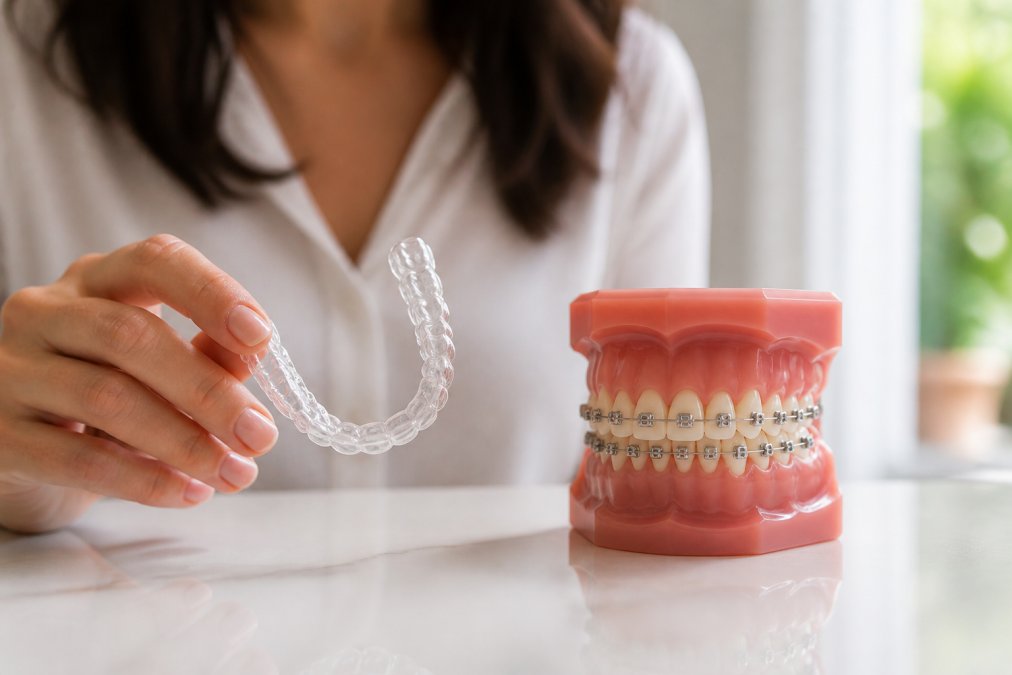
Both clear aligners and fixed braces move teeth into a better position. They differ in how they apply force, how visible they are, and how much responsibility falls on you.
How Each Appliance Works and Feels Day to Day
Clear aligners are custom-made removable trays, usually produced from a digital scan or dental impressions. Made from clear polyurethane resin, they are far less noticeable than metal. You wear each set for a set number of days, then move to the next tray, removing them to eat, drink anything other than water, and brush.
Pros and Cons at a Glance
| Feature | Clear Aligners | Fixed Braces |
|---|---|---|
| Visibility | Nearly invisible | Visible, unless lingual |
| Removability | Removable for eating and cleaning | Fixed for the whole treatment |
| Cleaning difficulty | Easier, normal brushing | Needs special brushes and floss |
| Diet restrictions | None, while trays are out | Avoid hard and sticky foods |
| Compliance needed | High, roughly 20-22 hours daily | Low, works on its own |
| Best for | Mild to moderate crowding | Complex bite correction |
Neither option is universally “better”. A common mistake is assuming aligners can fix anything braces can. For significant bite correction or rotated teeth, fixed braces can often give predictable results.
How Long Does Teeth Straightening Take for Adults?
Most adult orthodontic treatment takes between 6 and 24 months, depending on how much movement is needed. Minor crowding may resolve in under a year; complex bite correction can run closer to two.
What Affects Your Treatment Timeline
Several factors push that range up or down:
- Severity of the malocclusion and how far teeth need to travel
- Which appliance you choose, since aligners depend on wear time
- How consistently you wear removable trays
- Whether extractions or interproximal reduction are needed
- Your body’s individual response to gentle alignment forces
Accelerated orthodontics can shorten some treatments, but not every case suits it. Your clinician will give a realistic estimate after a full assessment, including 3D imaging and dental impressions.
Adult Teeth Straightening Cost: What You Are Actually Paying For
Pricing for adult teeth straightening depends on case complexity, appliance and treatment length, so no single figure applies to everyone. What helps is knowing the cost structure, typical bands, and the questions that stop a quote becoming a surprise.
What the Fee Should Cover
Your fee covers more than the hardware:
- Diagnosis and planning, including 3D imaging, digital scans and sometimes X-rays
- The custom-made appliance itself, whether aligners or braces
- Adjustment appointments throughout active treatment
- Retainers and the retention phase that follows
- Clinical oversight from a qualified professional at every stage
- Emergency appointments for broken brackets, lost aligners or discomfort
Ask whether retainers, removal of fixed braces, and post-treatment review appointments are included, these are most often excluded from a headline price.
Financing and Payment Options
Many private practices offer ways to spread the cost:
- Interest-free monthly instalments over the treatment period, usually arranged directly with the practice
- Third-party finance through a regulated credit provider, which may carry interest
- Deposit plus instalments, where a larger upfront payment reduces the monthly amount
- Upfront payment discounts, which some practices offer for settling in full
If you use a finance provider, check the total repayable rather than the monthly figure, and confirm the provider is authorised and regulated by the Financial Conduct Authority. For practice-arranged instalments, ask what happens if treatment runs longer than planned.
The Costs Patients Forget
Beyond the appliance itself, budget for:
- Replacement aligners or retainers if one is lost or broken, often £50 to £200 per item
- Retainer renewal every few years, as retainers wear, crack or become stained
- Extra hygiene appointments, since cleaning around braces is harder and some patients need more frequent professional cleaning
- Whitening or cosmetic work afterwards, if you want to even out colour once the braces come off
Ask what is included, what is not, and what happens if treatment takes longer than expected, then get the quote in writing before you commit.
Managing Discomfort, Oral Hygiene and Daily Life During Treatment
Skipping cleaning around fixed braces is the most common way patients end up with discoloured patches on their teeth. The straightening works, but the enamel is permanently marked. It takes two extra minutes a day to avoid.
Lifestyle adjustments are usually minor. Aligners come out for meals, so no restricted diet. Braces require cutting hard foods smaller and avoiding sticky sweets. Speech adapts within a week or two for most people, including those with lingual braces.
Retention and Relapse: Why the First Year After Treatment Matters Most
Teeth naturally drift back toward their original position, which is why the retention phase is not optional, and where treatment most often fails. Understanding why relapse happens, and what retention involves, is the difference between a result lasting decades and one that unravels within two years.
Why Teeth Move Back
The tissues around a moved tooth do not reset instantly. After active treatment ends:
- The periodontal ligament, the fibres anchoring each tooth into its socket, is stretched and needs time to reorganise around the new position
- The gum fibres in particular can take many months to remodel, and they exert a gentle pull back toward the old alignment
- The bone surrounding the roots remodels more slowly still, and the socket does not fully consolidate for up to a year or more
- Natural ageing changes continue regardless, with gradual crowding of the lower front teeth being a common pattern even in people who never had braces
Types of Retainer
Fixed retainers are thin wires bonded behind the front teeth, usually the lower front six and sometimes the upper. They are invisible, work continuously, and rely on nothing from you. Trade-offs: careful cleaning with interdental brushes to prevent plaque build-up, occasional detachment (requiring prompt re-bonding to avoid relapse), and long-term, often indefinite, placement.
Removable retainers come in two common forms:
- Vacuum-formed clear retainers, similar in appearance to aligners, made from a thin sheet of plastic moulded over a model of your finished teeth. Discreet and easy to wear, but they can crack, discolour and wear through over time.
- Hawley retainers, an acrylic base with a metal wire across the front. More durable than clear retainers and adjustable by the clinician, but more visible and bulkier.
Wear Schedules in Practice
A common pattern recommended by UK clinicians is:
- First few months after braces or aligners come off: full-time wear, removing only to eat, drink anything other than water, and clean
- Months three to twelve: night-time wear only, typically every night
- Beyond the first year: night-time wear continued long-term, often indefinitely, though some patients are able to reduce to a few nights a week if stability is good
The exact schedule depends on your case, age and how much movement was involved. The key point: the first year carries the highest relapse risk, and night-time wear is the minimum most clinicians accept long-term.
The Real Cost of Stopping
Stop wearing your retainer and the teeth will move. Not might. Will. Relapse is gradual and easy to miss until crowding is visible again, at which point you face a second round of treatment, often more complex than the first, because the roots and bone have already been through one cycle of movement.
A retainer that feels tight after a few nights out of wear is a warning sign, not a minor inconvenience. If it does not settle within a day or two of resuming wear, book a review, the sooner a small relapse is caught, the easier it is to correct.
Looking After Your Retainers
Retainers are a long-term commitment, so treat them accordingly:
- Clean removable retainers daily with cool water and a soft brush, hot water can warp them
- Use retainer cleaning tablets periodically to control bacteria and odour
- Store them in a rigid case when not in the mouth, never loose in a bag or pocket
- Keep them away from pets and hot surfaces, the two most common causes of replacement
- Bring them to every review appointment so the clinician can check fit and wear
Most clinicians recommend renewing retainers every few years as they wear. Budgeting from the outset avoids leaving a worn-out retainer out of the mouth because replacing it feels unnecessary, exactly when relapse happens.
Is Adult Teeth Straightening Right for You? A Decision Framework
Work through these questions honestly before booking anything:
- Are my teeth and gums healthy enough to support orthodontic treatment?
- Can I commit to wearing aligners around 20-22 hours a day, if I choose them?
- Can I manage the cleaning routine that braces require?
- Have I budgeted for retainers and follow-up appointments, not just the appliance?
- Am I choosing this for a specific event, or for long-term dental health?
- Have I had a full assessment, including X-rays and 3D imaging?
If you tick most of these, you are a realistic candidate. If unsure about any, a consultation is the right next step, a proper assessment confirms whether treatment is suitable and which appliance gives the most predictable result.
Ask what happens if you lose or break an aligner or retainer. The answer tells you a lot about how a practice handles the practical side of treatment, and it is a cost most patients never think to ask about upfront.
Conclusion
Straightening your teeth as an adult is a real commitment of time, money and daily discipline, and results depend on choosing the right appliance and sticking to the retention plan. At Smile Design Studio, we build personalised treatment plans around your dental health, lifestyle and goals, using advanced imaging and premium materials.
Frequently Asked Questions
Can you still straighten teeth as an adult?
Yes. Teeth can be moved at any age because the bone around them remodels continuously. Adult teeth straightening is routine in general and cosmetic dentistry, and treatment plans are built around your gum health, enamel condition and any existing restorations. The main difference from teenage treatment is that adult jaws have stopped growing, so complex bite correction may need a different approach. A consultation with a qualified dentist is the only way to confirm what is suitable for your mouth.
Does the NHS offer adult teeth straightening treatment?
NHS orthodontic treatment is generally prioritised for patients under 18 with a clear clinical need, and eligibility for adults is limited. Most adults who want clear aligners vs fixed braces, or who are focused on smile aesthetics, choose a private provider. If you are unsure whether you qualify, ask your dentist about NHS referral criteria or check the official NHS guidance before assuming you have to pay privately.
What is the most effective way for adults to straighten their teeth?
There is no single best option. Fixed braces give the most control for complex bite correction and do not rely on patient compliance. Clear aligners suit mild to moderate crowding and are discreet and removable, but they only work if worn for the required hours each day. Lingual braces sit behind the teeth and are hidden from view. Your treatment plan should match your case complexity, lifestyle and how reliably you will follow wear instructions.
How much does adult teeth straightening cost and what affects the price?
Adult teeth straightening cost depends on case complexity, the appliance chosen, treatment duration and whether any preparatory work such as interproximal reduction is needed. Private practices set their own fees, so pricing varies. Many providers offer financing options or staged payment plans. Ask for a written treatment plan with a full breakdown before you commit, and check the practice’s website or a consultation for current figures rather than relying on general estimates.
Related posts