How to Choose Conscious Sedation vs General Anesthesia
How to Choose Conscious Sedation vs General Anesthesia
Last Updated: October 30, 2026
Quick Summary
Conscious sedation keeps you awake and able to respond to simple instructions while reducing anxiety, whereas general anesthesia makes you fully unconscious with no ability to respond. Conscious sedation suits anxious patients and those with a strong gag reflex, while general anesthesia is reserved for complex treatment or patients who cannot cooperate awake.
- Conscious sedation includes inhalation with nitrous oxide, intravenous sedation, and oral sedation taken as a tablet.
- Sedation depth depends on dose, route, age, weight, medical history, and how you respond, not the drug alone.
- Inhalation sedation clears quickest, often within minutes of removing the mask.
- Local anaesthesia blocks pain while sedation eases fear, stress, and the gag reflex, so they are often combined.
- For intravenous sedation, you will usually fast beforehand and arrange a responsible adult to escort you home.
Table of Contents
- Conscious Sedation vs General Anesthesia: What’s the Difference?
- Awake or Asleep: Comparing Sedation Depth and Awareness
- How Long Does Dental Sedation Last?
- Local Anaesthesia vs Sedation Dentistry: What Each One Does
- Dental Sedation Safety: Risks, Monitoring and Who It Suits
- Preparation, Fasting and Recovery: What to Expect
- Booking a Sedation Consultation at Smile Design Studio
- Frequently Asked Questions
Conscious Sedation vs General Anesthesia: What’s the Difference?
Conscious sedation vs general anesthesia dentistry comes down to one question: do you need to be asleep, or just relaxed? Conscious sedation keeps you awake and able to respond, while general anesthesia makes you fully unconscious (Royal Orthopaedic Hospital).
Below, we break down how each one feels, how deep the sedation goes, and which option suits which patient.
What Conscious Sedation Actually Feels Like
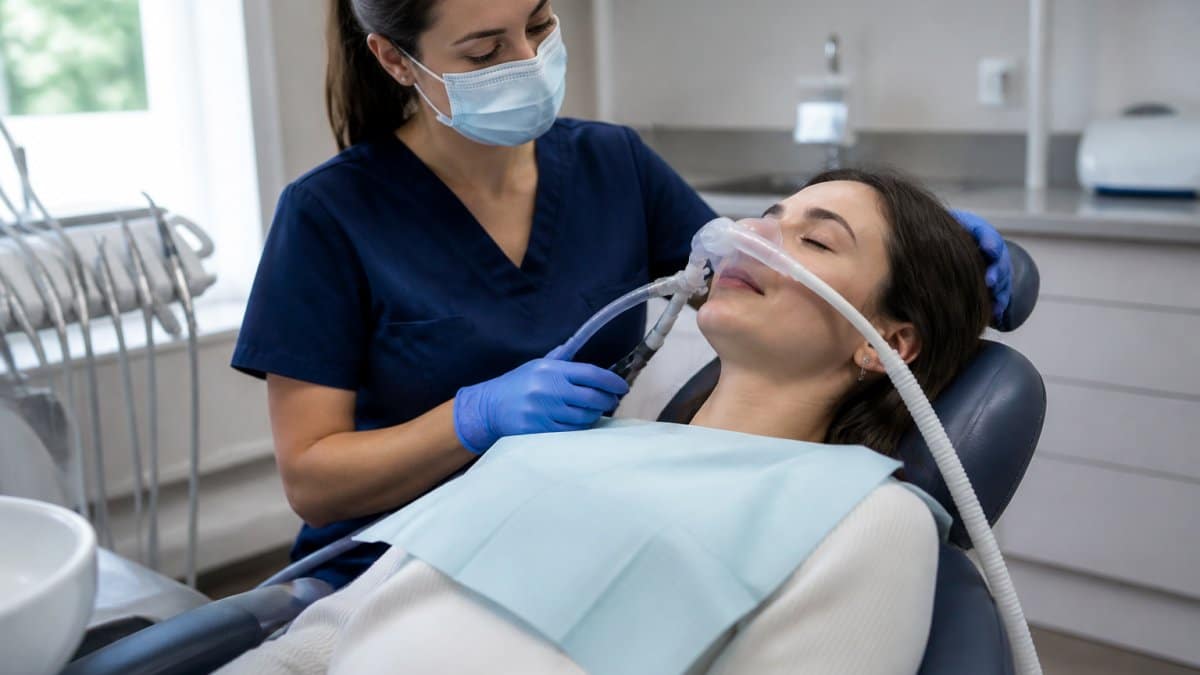
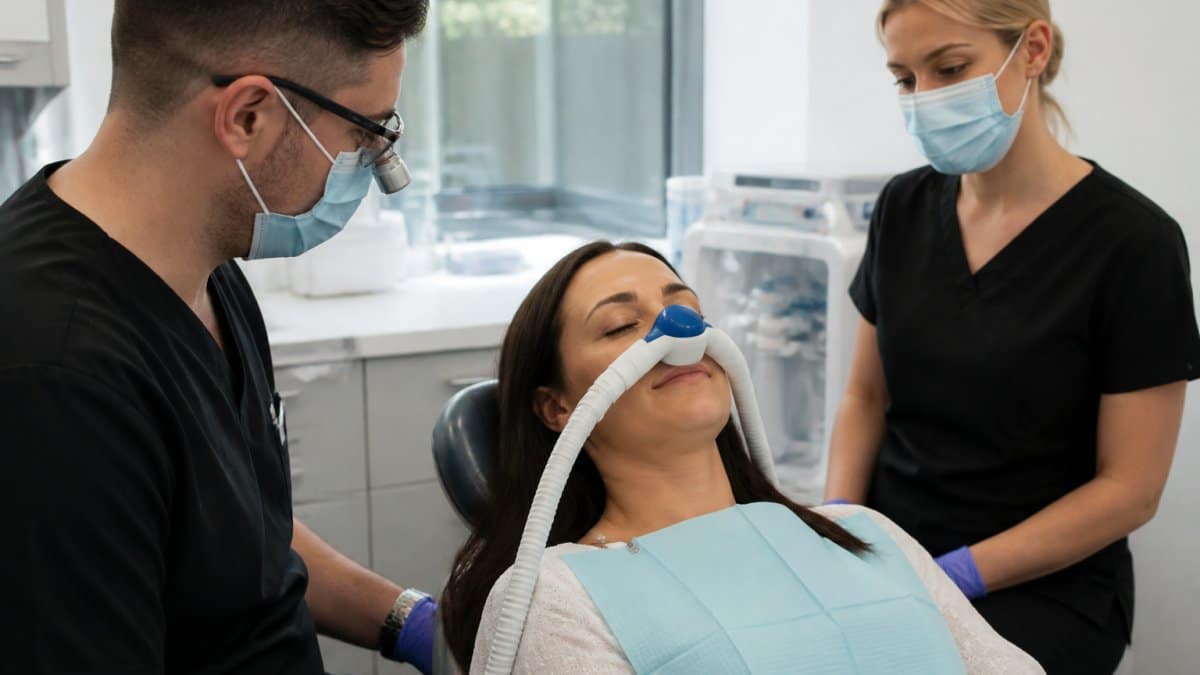
Many people describe conscious sedation as a relaxed, drowsy feeling. You feel relaxed and may not remember much of the appointment. But you stay awake enough to open your mouth on request or lift a hand if asked.
The main sedation types are:
- Inhalation sedation using nitrous oxide, often called gas and air
- Intravenous sedation, where sedative is given through a vein
- Oral sedation, taken as a tablet before treatment
You remain responsive to verbal cues throughout. Your protective reflexes generally remain intact, which is one reason conscious sedation differs from general anaesthesia.
What General Anesthesia Involves
General anesthesia puts you fully to sleep. You cannot respond to verbal cues, and your protective reflexes are lost.
It is reserved for complex treatment, certain medical needs, or patients who cannot cooperate awake. It usually happens in a hospital setting, not a standard dental chair.
Best for: complex surgical cases or patients who cannot tolerate any awake treatment.
Skip if: you simply feel anxious, since sedation usually covers that.
Awake or Asleep: Comparing Sedation Depth and Awareness
Most comparison pages reduce this to ‘awake versus asleep’, but that framing hides the detail that actually matters when you are choosing a sedation option. Sedation is not a switch; it is a continuum of depth, and your responsiveness, airway protection and monitoring needs change at each step along it.
The sedation continuum, explained
Clinicians commonly describe four levels of sedation, from lightest to deepest:
- Minimal sedation (anxiolysis). You are awake and calm, respond normally to conversation, and your breathing and airway are unaffected. Inhalation sedation with nitrous oxide sits here for many patients.
- Moderate sedation (conscious sedation). You are drowsy but respond purposefully to verbal commands, either alone or with light touch. You can usually maintain your own airway without help, and your breathing is adequate. This is the level most people mean by ‘conscious sedation’ in dentistry, typically achieved with intravenous or oral sedatives.
- Deep sedation. You may respond only to repeated or painful stimulation, and you may not be able to maintain your airway reliably. Breathing can be depressed, and support may be needed. Deep sedation is not the same as conscious sedation and requires a higher level of monitoring and trained staff.
A key clinical point that most comparison articles miss: the level reached is not fixed by the drug alone. It depends on the dose, the route, how quickly the drug is given, your age, weight, medical history and how you respond. A moderate sedation plan can drift deeper, which is why continuous monitoring and trained supervision matter at every level.
Awareness and responsiveness, level by level
| Level | Typical awareness | Response to commands | Airway and breathing | Usual dental setting |
|---|---|---|---|---|
| Minimal | Awake, relaxed | Normal | Unaffected | Dental practice |
| Moderate (conscious sedation) | Drowsy, may have reduced memory | Purposeful to verbal command or light touch | Usually self-maintained | Dental practice with trained sedation team |
| Deep | Reduced, may not recall | Only to repeated or painful stimulation | May need support | Specialist or hospital setting |
| General anaesthesia | Unconscious, no memory | None | Must be supported | Hospital or specialist anaesthesia setting |
Under conscious sedation you may remember little of the appointment, which is called amnesia, but that is not the same as being unconscious. You can still follow simple instructions such as opening your mouth or turning your head. Under general anaesthesia there is no awareness and no ability to respond, and your protective reflexes are lost, so your airway must be protected by an anaesthesia team.
Pain control versus anxiety relief
Another distinction that gets blurred: sedation and pain relief are separate jobs. Conscious sedation primarily reduces anxiety and the gag reflex; pain during treatment is usually controlled with local anaesthesia. General anaesthesia provides unconsciousness and pain relief through the anaesthetic itself, but local anaesthesia may still be used alongside it for post-operative comfort. This is why the two are often combined rather than treated as alternatives.
The practical question is not simply ‘awake or asleep’ but ‘what depth does my treatment and my health safely allow?’ That is a clinical judgement based on the procedure, your medical history, your anxiety and your ability to cooperate, and it is exactly what a sedation consultation is for.
How Long Does Dental Sedation Last?
The effects of dental sedation usually wear off within a few hours, depending on the type and dose. Intravenous sedation can leave you drowsy for longer, so you should not drive or work that day. (Source: NHS guidelines on anaesthesia)
Plan for the rest of your day to be quiet. Arrange for someone to take you home after intravenous sedation.
Local Anaesthesia vs Sedation Dentistry: What Each One Does
Local anaesthesia and sedation dentistry do two different jobs, and they are often used together. Local anaesthesia numbs the area being treated, so you feel no pain. Sedation dentistry calms your mind and reduces anxiety.
Think of it this way:
- Local anaesthesia blocks pain signals in one spot
- Sedation eases fear, stress, and the gag reflex
- Together they keep you comfortable and pain-free
If needle phobia is your main worry, sedation can help you through the injection itself. Many nervous patients find the combination far easier than either option alone.
Dental Sedation Safety: Risks, Monitoring and Who It Suits
Safety is where the choice between conscious sedation and general anaesthesia becomes most practical, and it is where brief comparison pages tend to stay vague. A clearer way to think about it is to compare what is being monitored, what can go wrong, and who is best placed to manage it.
Monitoring compared
- Conscious sedation in a dental practice. Sedation is typically monitored for breathing, oxygen levels, blood pressure and level of consciousness throughout treatment. You remain responsive, which is itself a safety feature: you can tell the team how you feel and follow instructions.
- General anaesthesia. Monitoring is more intensive because you cannot respond or protect your airway. An anaesthetist manages your breathing and airway, often with a tube or airway device, and monitors oxygen, carbon dioxide, blood pressure, heart rhythm and depth of anaesthesia. This is why general anaesthesia is typically delivered in a hospital or specialist setting with recovery facilities.
The practical trade-off is not ‘safe versus unsafe’ but ‘what level of support matches the depth of sedation’. Deeper sedation needs more monitoring and more trained people, which is why setting matters as much as the drug.
Common side effects and rarer risks
Most side effects are short-lived and manageable:
- Drowsiness and a heavy, relaxed feeling that wears off over hours
- Headache, particularly after inhalation sedation
- Nausea or vomiting, more common with some intravenous agents
Rarer but more serious risks include depressed breathing, low blood pressure, an allergic reaction to a sedative or anaesthetic agent, and aspiration. These are uncommon when patients are properly assessed and monitored, but they are the reason a full medical history review comes first and why you should never withhold information about your medications, allergies or health conditions.
Always disclose all medications, supplements, allergies, previous reactions to sedation or anaesthesia, and any heart, lung, kidney or liver conditions. This is where avoidable risks most often creep in, and it directly shapes which sedation option is safe for you.
Who each option tends to suit
A common pattern in practice is:
- Conscious sedation suits anxious patients, those with a strong gag reflex, people needing longer or multiple treatments, and many patients who want to avoid general anaesthesia. It also suits some patients with medical conditions that make general anaesthesia higher risk, provided the sedation plan is tailored.
- General anaesthesia tends to be reserved for complex surgical treatment, certain medical or behavioural needs, children who cannot cooperate safely awake, and situations where treatment cannot be delivered with sedation alone. It is not usually a first choice simply for dental anxiety, because conscious sedation often covers that need with less disruption.
Suitability depends on your health, the procedure, your age, your anxiety and your ability to cooperate. Children and patients with additional medical needs may need a tailored plan and, in some cases, a specialist referral.
You can read our step-by-step guide to overcoming extreme dental phobia if anxiety is the main driver, or find gentle, sedation-friendly dentists in your area to discuss which level of sedation is appropriate for you.
Preparation, Fasting and Recovery: What to Expect
Preparation for sedation is straightforward but important. For intravenous sedation, you will usually be asked to fast for a set period beforehand and to arrange a responsible adult to escort you home. Inhalation sedation has lighter requirements.
After treatment:
- Rest for the remainder of the day
- Avoid driving, cycling, or operating machinery
- Drink water and eat gently once you feel alert
You can explore our general dentistry and hygiene services to see how sedation fits around routine care and to request an appointment.
Booking a Sedation Consultation at Smile Design Studio
A consultation is a sensible way to decide between conscious sedation and general anesthesia. A consultation is the right place to review your medical history, discuss your anxiety, and talk through which option suits your treatment.
Not sure what to expect? You can read our complete guide to what happens at a dental consultation before you come in. When you are ready, book a private dental consultation to discuss your options.
Frequently Asked Questions
What is the difference between local anaesthesia and sedation?
Local anaesthesia numbs a specific area of the mouth so you feel no pain, but you remain fully awake and aware. Sedation dentistry uses medication to relax you and reduce anxiety, and conscious sedation keeps you responsive throughout. The two are often used together: a local anaesthetic blocks pain while sedation calms nerves and can reduce memory of the treatment. Your dentist will explain which combination suits your procedure and medical history.
Are you awake during conscious sedation at the dentist?
Yes. With conscious sedation you stay awake and can respond to verbal cues from your dentist, though you may feel drowsy and relaxed. Inhalation sedation with nitrous oxide, often called gas and air, wears off quickly, while intravenous sedation produces deeper relaxation and often some amnesia. You remain able to follow instructions and your protective reflexes stay intact, which is why conscious sedation is generally considered lower risk than general anaesthesia.
Is conscious sedation safe?
Sedation involves monitoring of consciousness, breathing and airway, and side effects such as nausea or a temporary drop in blood pressure can occur. Dental sedation safety depends on correct dosing, fasting guidance and having a responsible adult escort you home. Always disclose medications and health conditions at consultation so your team can plan appropriately.
How long does it take to recover from dental sedation?
Recovery varies by method. Inhalation sedation with nitrous oxide typically wears off within minutes, and most people can drive themselves home after a short observation period if their dentist confirms they are fit. Intravenous sedation can leave you drowsy for several hours, so you should arrange an escort and avoid driving, operating machinery or signing legal documents for 24 hours. Follow your practice’s aftercare instructions and contact them if you feel unwell.
Choosing how to manage dental anxiety is a real decision, and you do not have to make it alone. At Smile Design Studio, our team supports nervous patients and children with personalised treatment plans, advanced equipment, and a calm, modern environment. Get started with Smile Design Studio and take the first step toward comfortable, confident dental care.

Related posts