Porcelain Veneers for Men: Before and After Guide
Porcelain Veneers for Men: Before and After Guide
Last Updated: October 23, 2026
Quick Summary
Porcelain veneers for men before and after results show ceramic veneers correcting chips, closing gaps and evening out tooth colour while still looking natural. Improvement comes from correcting shape and colour together, not whitening alone, and most men want a subtle, healthy-looking result rather than bright white blocks.
- Check that before and after photos use identical lighting, the same angle and labelled veneer counts.
- Male-focused design uses slightly less rounded incisal edges and a shade one or two steps warmer.
- Conventional preparation removes a fraction of a millimetre to around half a millimetre of enamel.
- Treatment usually runs across two to three appointments, with one to three weeks for ceramic fabrication.
- Porcelain veneers commonly last around ten to fifteen years, often longer with good care.
Table of Contents
- Porcelain Veneers for Men: What Before and After Results Show
- Why Men Choose a Smile Transformation
- Reading Before and After Case Photos Properly
- Male Veneers Before and After: Case Comparisons
- Natural-Looking Veneers for Men: Design Choices That Matter
- Porcelain Veneer Preparation Types Explained
- The Treatment Process, Recovery and Timeline
- How Long Do Porcelain Veneers Last?
- Candidacy, Risks and Limitations
- Frequently Asked Questions
Porcelain Veneers for Men: What Before and After Results Show
Porcelain veneers for men before and after results show how carefully shaped ceramic can correct chips, close gaps and even out tooth colour while still looking natural.
A before and after photo is a marketing tool as much as a clinical record. Trust the ones taken under the same lighting, at the same angle, with the shade and number of veneers labelled.
Why Men Choose a Smile Transformation
Confidence drives most enquiries we see. Discoloured, chipped or uneven teeth show up in every photograph, meeting and video call, and many men simply want the issue resolved.
A smile transformation with porcelain veneers addresses several concerns at once: staining whitening cannot shift, small chips, minor gaps and worn or uneven teeth.
What most guides miss is that men often want a subtler result than the word “veneer” suggests.
Reading Before and After Case Photos Properly
A useful case photo is a standardised record, not a beauty shot: consistent lighting, the same camera angle, retracted lips showing the full tooth display, and a label stating how many veneers were placed and which material was used.
Three checks separate a credible photo gallery from a flattering one:
- Same conditions: before and after shot under identical lighting and background.
- Labelled detail: number of veneers, shade selection and whether upper veneers, lower veneers or both were treated.
- Natural expression: a relaxed smile, not a staged grimace that hides the gum line.
If a gallery only shows close-up “after” shots with no matching “before”, treat it as advertising. You can review case studies to see how patient work is labelled and presented.
Male Veneers Before and After: Case Comparisons
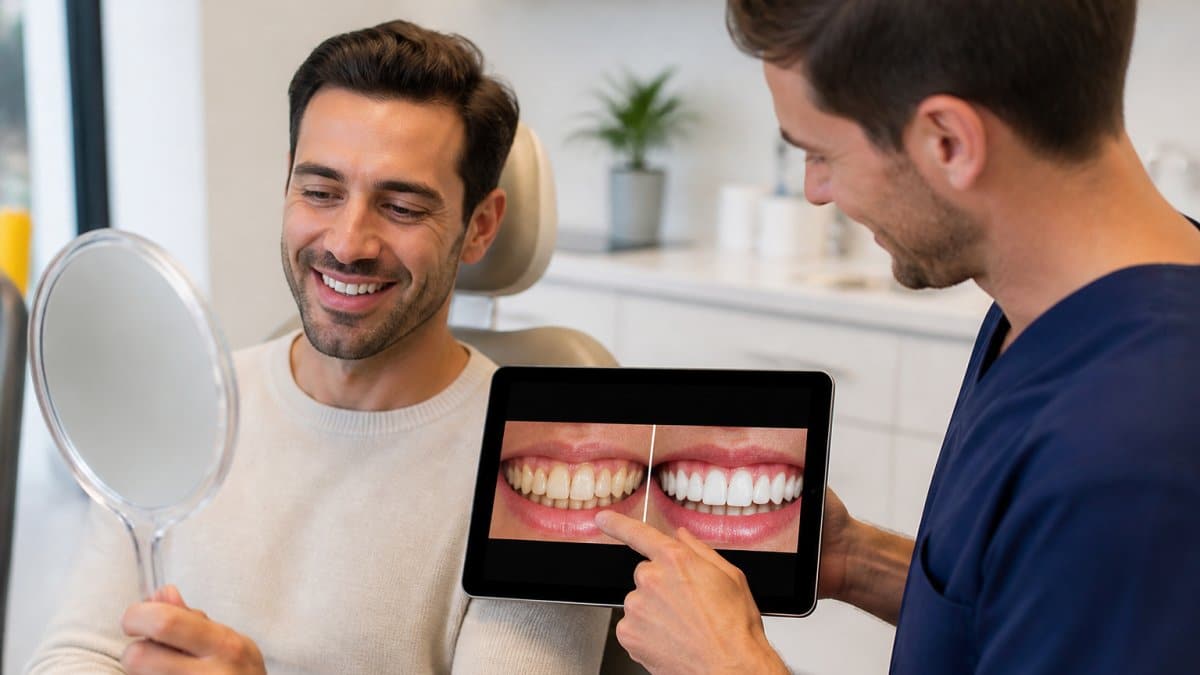
Male veneers before and after comparisons cluster around a few common presentations. You can review before-and-after case studies to judge results for yourself.
| Starting presentation | Typical correction | Veneers usually needed | Design choice that matters most | What changes in the after photo |
|---|---|---|---|---|
| Worn, chipped front teeth | Rebuild length and edge shape | 4-8 upper veneers | Incisal edge position and slight length variation to avoid a flat, uniform edge | Even incisal edges, restored smile line |
| Staining resistant to whitening | Mask intrinsic discolouration | 6-10 upper veneers | Shade matched to the eye whites and skin tone rather than the lightest tab | Consistent tooth colour across the display |
| Small gaps and uneven teeth | Close spaces, align appearance | 6-10 upper veneers | Proportions that keep the central incisors dominant without over-widening | Balanced spacing without orthodontics |
| Short or square tooth shape | Lengthen and soften contours | 8-10 upper veneers | Subtle surface texture and softened embrasures so the smile reads as natural | More proportionate tooth shape |
| Upper and lower display issues | Combined upper and lower treatment | 8-16 total | Shade and texture continuity between arches so the lower teeth do not look like an afterthought | Cohesive bite display and shade match |
The pattern is consistent: improvement comes from correcting shape and colour together, not whitening alone. Don’t judge a case by brightness, look at the edges, the gum line and whether the teeth still look like they belong to that face.
What Male-Focused Smile Design Actually Means
Male-focused design is not about stereotypes such as “stronger” teeth. It is about proportion and restraint: most male patients want a result that reads as healthy and well-kept rather than obviously treated. In practice that usually means:
- Slightly less rounded incisal edges than a conventional female smile design, with subtle variation in length across the centrals and laterals.
- A shade that sits one or two steps warmer than the brightest whitening result, so the teeth do not look bleached against the skin.
- Surface texture and perikymata-like characterisation carried into the ceramic so light reflects the way it does on natural enamel.
These decisions are made at the planning stage, not at the chair, and explain why two men with the same starting presentation can end up with visibly different results.
How to Read a Standardised Before-and-After Case
When you review any gallery, including ours, check for the following:
- Consistent capture conditions, same lighting, same background, same camera angle, and ideally the same retractor so the full tooth display is visible in both images.
- Labelled treatment detail, the number of veneers, the material, the shade selected, and whether upper veneers, lower veneers or both arches were treated.
- A relaxed expression, a natural smile rather than a staged grimace that hides the gum line or the incisal edges.
- A stated starting concern, the caption should say what was being corrected (chipping, discolouration, spacing, wear) so you can judge whether the after image actually addresses it.
If a gallery only shows close-up after shots with no matching before, treat it as advertising. Review case studies to see how patient work is labelled, including the starting concern and number of veneers placed.
Natural-Looking Veneers for Men: Design Choices That Matter
Natural-looking veneers for men depend on three decisions made before any tooth is prepared: shade, shape and surface texture. Get these right and the result reads as healthy teeth. Get them wrong and the smile looks manufactured.
Men often suit a shade slightly warmer than the brightest whitening result, matched to the whites of the eyes rather than a shade guide’s lightest tab.
Shade Selection and Tooth Shape
Shade selection should happen in daylight, with your input, and with a trial smile where possible. We favour a “natural appearance” approach: lifelike results that improve the smile without announcing the treatment.
For tooth shape, the design should follow the face. If you are weighing materials, our guide on composite vs porcelain veneers sets out the differences, and our broader cosmetic dentistry guide covers shade and shape planning in more depth.
Porcelain Veneer Preparation Types Explained
Porcelain veneer preparation types fall into three categories: conventional, minimal-prep and no-prep. The right choice depends on tooth position, existing restorations and how much the shape needs to change.
Conventional preparation removes a thin layer of enamel, typically a fraction of a millimetre to around half a millimetre, so the ceramic sits flush with the gum line.
A common mistake is assuming “less drilling” always means a better result. Where teeth are already worn or heavily restored, conventional preparation often gives a more lifelike outcome.
The Treatment Process, Recovery and Timeline
Treatment usually runs across two to three appointments, depending on the preparation type and whether a trial smile is used. A typical pathway:
- Consultation and planning, examination, clinical photographs, shade discussion in daylight, and a written plan setting out the number of veneers, the material and the preparation approach.
- Preparation appointment, minimal shaping of the teeth under local anaesthetic, digital scans or impressions, and fitting of temporary veneers. This is also when the bite is checked and any adjustments to tooth reduction are made.
- Trial smile review, where a trial smile or mock-up is used, you see and approve the proposed shape and shade before the final ceramic is made. This step is optional but valuable for anyone unsure about tooth length or contour.
- Veneer placement, bonding the finished veneers, checking the bite, polishing the margins and giving aftercare instructions.
The gap between preparation and placement is typically one to three weeks while the ceramic is fabricated. Temporary veneers can feel bulkier than the final result and may alter your speech slightly for the first day or two.
Preparation Types and What They Mean for Recovery
Preparation type affects both the appointment and the recovery:
- Conventional preparation removes a thin layer of enamel, typically a fraction of a millimetre to around half a millimetre, so the ceramic sits flush with the gum line. It gives the most lifelike result where teeth are worn or heavily restored, but it is irreversible.
- Minimal-prep veneers remove less enamel and suit teeth that need only modest shape or colour correction.
- No-prep veneers sit directly on existing enamel. They sound appealing, but they are not suitable for every case and can leave teeth looking bulkier because the ceramic adds thickness rather than replacing tooth structure.
A common mistake is assuming “less drilling” always means a better result. Where teeth are already worn or heavily restored, conventional preparation often gives a more lifelike outcome. We assess this at consultation rather than promising a no-prep result in advance.
Recovery, Sensitivity and Aftercare
Most people return to normal work the same day as preparation and placement. Mild sensitivity to hot and cold is common for a few days after preparation and briefly after bonding, usually settling without intervention. In the meantime:
- Avoid very hot or cold drinks for the first few days.
- Stick to softer foods if the teeth feel tender.
- Use a soft-bristled brush and a non-abrasive fluoride toothpaste.
A follow-up appointment is typically arranged within a few weeks of placement to check the margins, bite and gum response. Because pricing depends on the number of veneers, material and case complexity, we confirm the plan in writing before any preparation begins. You can check our price list to see costs before booking.
How Long Do Porcelain Veneers Last?
Porcelain veneers commonly last around ten to fifteen years, often longer with good care. Durability depends on the bond, the bite and daily habits rather than the ceramic alone.
Stain resistance is one of porcelain’s real advantages: the glazed surface does not absorb colour the way natural enamel does. That does not make veneers indestructible. Biting nails, opening packaging with the teeth or grinding at night can chip them, and a night guard is a sensible investment for anyone who clenches.
Maintenance and Long-Term Outcomes
Long-term outcomes hinge on simple routines: brush twice daily with a non-abrasive fluoride toothpaste, clean between the teeth, keep regular check-ups so margins can be checked, and avoid abrasive whitening pastes that dull the glaze.
Maintenance is unglamorous and it is the single biggest factor in how a smile makeover holds up.
Candidacy, Risks and Limitations
Veneers suit adults with healthy teeth and gums and enough sound enamel to bond to. They are not the right answer for active gum disease, heavy decay or a bite that needs orthodontic correction first.
Risks and limitations to weigh honestly:
- Irreversible preparation: conventional preparation removes enamel permanently.
- Sensitivity: temporary, but real for some patients.
- Chipping and debonding: possible, especially with grinding or nail biting.
If you have questions about pain or past dental anxiety, a consultation is the right place to raise them.
A smile makeover is a real commitment, and it deserves a plan built around your face, your bite and your budget rather than a template. Our step-by-step smile makeover guide walks you through the wider journey.
Frequently Asked Questions
How long do porcelain veneers last on front teeth?
Porcelain veneers on front teeth commonly last around 10 to 15 years, and some last longer with good care. Longevity depends on the skill of the dentist, the quality of the porcelain, your bite and your daily habits. Grinding, nail biting and opening packaging with your teeth all shorten lifespan. Regular check-ups let your dentist spot chipped edges or worn margins early, when repairs are simpler. Ask your practice about their own follow-up schedule and what aftercare they provide.
What are the different types of veneer preparation?
Preparation falls into three broad groups: conventional preparation, which removes a thin layer of enamel to make room for the porcelain; minimal-prep, which conserves most of the enamel; and no-prep, where veneers bond directly onto the existing surface. Conventional preparation suits larger corrections of shape, colour or alignment. Minimal-prep and no-prep suit smaller refinements and need enough healthy enamel to bond to. Your dentist will recommend a type after assessing your teeth, bite and goals.
Do porcelain veneers look natural on men?
Yes, when the design accounts for male facial features. Men often suit slightly squarer tooth shapes, less rounded incisal edges and a shade that matches the whites of the eyes rather than an artificial bright white. Natural-looking veneers for men come from custom design: your dentist should plan translucency, surface texture and shade before any permanent work. Ask to see clearly labelled before and after cases of male patients so you can judge the style rather than just the whiteness.
How much do porcelain veneers cost in the UK?
Pricing varies by practice, the number of veneers, the preparation type and the laboratory used, so there is no single figure. Pricing is not published, and you should request a written quote after a consultation. That quote should set out the number of veneers, whether temporary veneers are included, review appointments and what happens if a veneer chips. Compare total treatment plans rather than headline per-tooth prices, because inclusions differ between practices.

Related posts